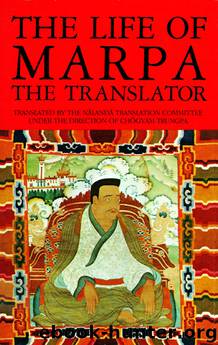
The Life of Marpa the Translator by Tsangnyon Heruka
Author:Tsangnyon Heruka
Language: eng
Format: epub
Publisher: Penguin Random House LLC (Publisher Services)
1. This prophecy by Tilopa, Nāropa’s guru, is given in full on p. 88. It is also found in Nāropa’s biography, p. 95
2. According to Tāranātha in his Sgyu-’phrul chen-mo’i khrid-yig rgyal-ba’i lam-bzang, one can do this practice based on either the expanded, intermediate, or abbreviated sādhana written by Kukkurīpā. Tāranātha then goes on to present a brief but detailed synopsis of the three yogas. The inferior yoga of form (dman-pa dbyibs kyi rnal-’byor) involves visualizing oneself as Mahāmāyā, who appears as inseparable appearance and emptiness, like a rainbow. The profound yoga of mantra (zab-pa sngags kyi rnal-’byor) uses the complex practices of the illusory body of nāḍī, prāṇa, and bindu. The ultimate yoga of dharma (mthar-thug chos kyi rnal-’byor) concerns the ordinary and extraordinary bringing of whatever occurs to the path. See the Bka’-brgyud sngags-mdzod, vol. 3, no. 11, pp. 281-293.
3. Understanding, experience, and realization (T: go, nyams-myong, rtogs) are three stages in the practice of mahāmudrā. They are also called “the three stages of birth’ (T: skye-lugs gsum). In the Nges-don phyag-rgya-chen-po’i sgom-rim gsal-bar byed-pa’i legs-bshad zia-ba’i ’od-zer (fol. 329A), Trashi Namgyal writes:
According to Lord [Tsangpa] Gyare,
“Understanding arises from analytical
investigation; the experiences are
strong and weak bliss and luminosity;
realization is recognizing things as they are.”
See also Guenther’s The Royal Song of Saraha, pp. 116-7, n. 42.
4. Striking phenomena with mudrā (T: snang-ba rgya-yis-thebs): this refers to an awareness that abruptly brings one back to sacred outlook, the view of mahāmudrā. Phenomena are not regarded as something separate from mahāmudrā, therefore there is no dwelling on any experience of great bliss.
5. Life force (T: srog-rtsol) and descent (T: ’pho-ba) refer to different aspects of caṇḍālī practice. Life force refers to the inner heat that is generated and that blazes up, causing the bodhicitta to descend as great bliss.
6. According to Tāranātha’s commentary on the Mahāmāyā, the three illusions are: (1) illusion of phenomenal appearances (T: snang-ba sgyu-ma), (2) illusion of dream (T: rmi-lam sgyu-ma), and (3) illusion of pardo (T: bar-do sgyuma). See Bka’-brgyud sngags-mdzod, vol. 3, no. 11, Sgyu-’phrul, pp. 291:3-292:5.
7. This line refers to the difficult hardships that Marpa put Milarepa through in order to purify him of his previous evil deeds and make him a worthy vessel for the teachings. Marpa promised to give Mila teaching after Mila had built a small castle, or tower, for his son, Tarma Dode. (The name Sekhar literally means “the son’s castle.”) However, Marpa changed his mind two times and each time he had Mila take down his construction, which was partially completed, and start over again. In building these towers and continually anticipating his receiving the teachings only to be disappointed, Mila was pushed to the limits of physical and mental exhaustion.
When at last the Sekhar was completed, Marpa hosted a large ceremony in which his son’s coming of age was celebrated and the Sekhar was consecrated. (In fact, the song on pp. 69-70 is included in Mila’s biography). It was the day after this celebration that Mila finally gave up hope of ever receiving teachings and was ready to kill himself.
Download
This site does not store any files on its server. We only index and link to content provided by other sites. Please contact the content providers to delete copyright contents if any and email us, we'll remove relevant links or contents immediately.
The Way of Zen by Alan W. Watts(6619)
Ego Is the Enemy by Ryan Holiday(5453)
The Art of Happiness by The Dalai Lama(4132)
The Book of Joy by Dalai Lama(3989)
Why Buddhism is True by Robert Wright(3458)
Spark Joy by Marie Kondo(3306)
Shift into Freedom by Loch Kelly(3200)
Happiness by Matthieu Ricard(3051)
A Monk's Guide to a Clean House and Mind by Shoukei Matsumoto(2917)
The Lost Art of Good Conversation by Sakyong Mipham(2657)
The Meaning of the Library by unknow(2576)
The Unfettered Mind: Writings from a Zen Master to a Master Swordsman by Takuan Soho(2312)
The Third Eye by T. Lobsang Rampa(2271)
Anthology by T J(2216)
Red Shambhala by Andrei Znamenski(2205)
The Diamond Cutter by Geshe Michael Roach(2065)
Thoughts Without A Thinker: Psychotherapy from a Buddhist Perspective by Epstein Mark(2029)
Twilight of Idols and Anti-Christ by Friedrich Nietzsche(1897)
Advice Not Given by Mark Epstein(1883)
